The Real Risk in AI Transformation Isn’t Speed. It’s a Lack of Coherence
Agentic AI will spread unevenly across the enterprise. The challenge for leaders is turning that fragmented momentum into synchronized, scalable transformation.
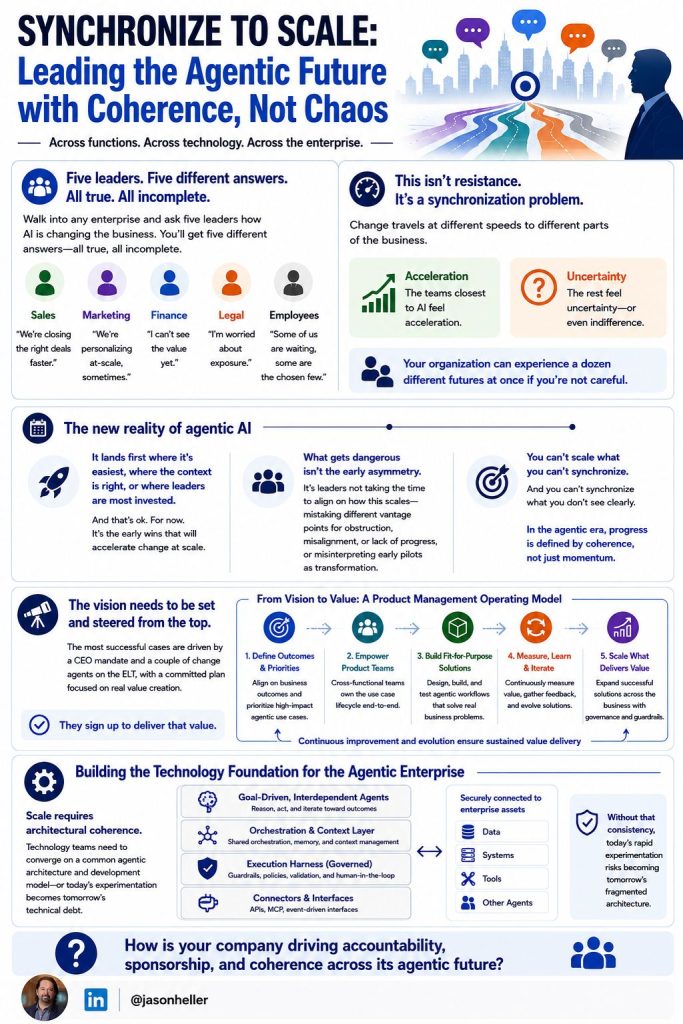
Walk into almost any large company and ask five leaders how AI is changing the business. You’ll probably get five different answers—all true, all incomplete.
Technology may be experimenting aggressively with new models and platforms. Sales or marketing teams may be building solutions with whatever resources they can find. Finance may still be looking for evidence of enterprise value. Legal is focused on risk and exposure. Meanwhile, the employee experience can range from barely changed to fundamentally transformed.
That doesn’t necessarily mean the organization is misaligned or resistant to change. It’s a natural consequence of AI reaching different parts of the enterprise at different speeds.
The challenge is what happens next.
Early asymmetry is healthy. Fragmentation isn’t.
Agentic AI will rarely arrive through one coordinated, enterprise-wide transformation. It will take hold first where the use cases are compelling, the data and technology are ready, and leaders are willing to invest.
That’s a good thing. Companies need experimentation, ambitious teams willing to move first, and early wins that demonstrate what’s possible.
The danger comes when leaders mistake those wins for transformation, or when individual teams continue down independent paths for too long. Different perspectives begin to look like disagreement. Similar problems get solved multiple times. Technology choices made for pilots quietly become permanent architecture.
The organization can be moving incredibly fast without actually moving together.
You can’t scale what you can’t synchronize. And you can’t synchronize what you don’t see clearly.
Accountability has to start at the top
The companies making meaningful progress tend to have something beyond an AI strategy: senior leaders who have committed themselves to specific business outcomes.
A CEO mandate matters, but so do executive change agents who are willing to put their names against the value AI is expected to create.
That changes the conversation from “What can we do with AI?” to “What business outcomes are we going to deliver, and where can AI materially change our ability to deliver them?”
From there, accountability can cascade into a product management model.
Rather than treating AI as a collection of technology projects, cross-functional teams own high-value use cases from conception through deployment and continuous improvement. They build fit-for-purpose solutions against clearly defined outcomes, measure whether those outcomes are being achieved, and continue evolving the product as the business, users, data, and technology change.
This is particularly important with agentic systems. These aren’t applications that should simply be built, deployed, and declared finished. They need to evolve as the context around them changes and as new capabilities become available.
The technology model has to converge too
There is a parallel challenge happening underneath the operating model.
As teams experiment, they are making choices about models, agent frameworks, orchestration, context, integration, and governance. Some variation is necessary—experimentation is part of the process. But enterprises also need a common architectural direction.
The emerging model moves beyond fully deterministic applications toward goal-driven, interdependent agents that can reason, act, and iterate within governed execution environments. Shared orchestration and context layers allow those agents to work together, while APIs, MCP, and event-driven interfaces connect them securely to enterprise data, systems, tools, and other agents.
This doesn’t mean every team needs to use identical technology. It means establishing enough consistency in architecture, governance, and development patterns that what works can eventually become part of a coherent enterprise ecosystem rather than another technology silo.
Without that discipline, today’s rapid experimentation risks becoming tomorrow’s fragmented architecture.
From momentum to coherence
Speed still matters. Enterprises that spend years designing the perfect AI operating model before acting will miss enormous opportunities. But speed alone isn’t transformation.
The objective isn’t to eliminate experimentation or force every team onto exactly the same path. It’s to create enough synchronization that successful experiments can become enterprise capabilities—and enough coherence that those capabilities ultimately fit together.
That means connecting executive sponsorship to measurable business value, business value to accountable product teams, and those product teams to a technology architecture capable of supporting what they build at scale.
The agentic enterprise will emerge unevenly. That’s inevitable. The leadership challenge is making sure all of those moving pieces are ultimately converging on the same future.
In the agentic era, progress won’t be defined by how many AI initiatives an enterprise has launched. It will be defined by how coherently they come together.