You Don’t Lose Your Best People When They Decide to Leave
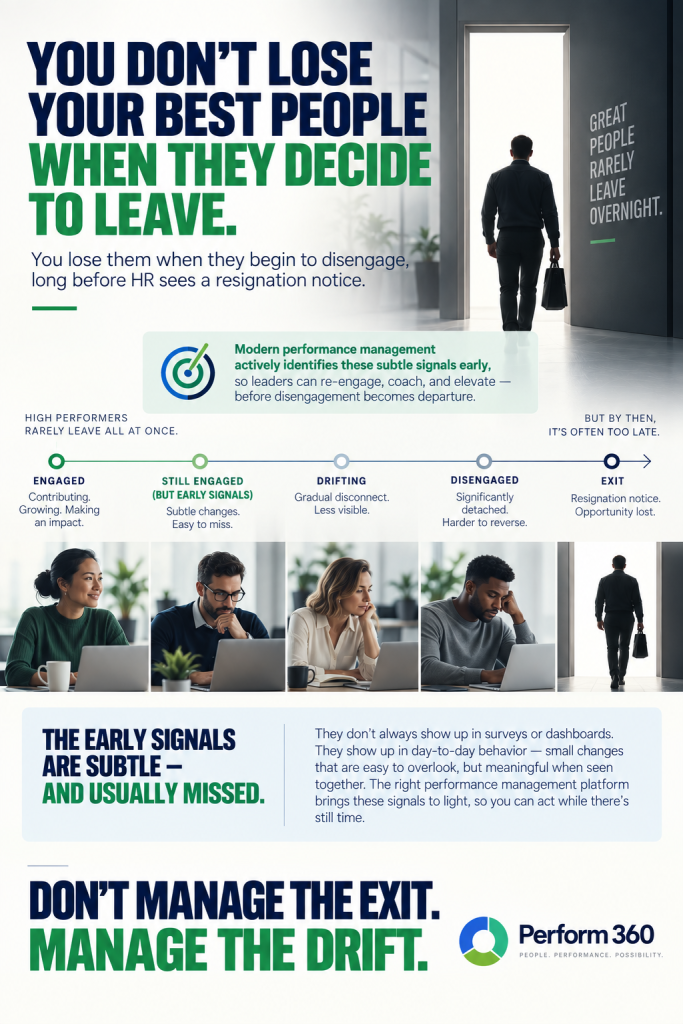
The signs usually appear much earlier. The challenge is recognizing them while there is still time to act.
You don’t lose your best people when they decide to leave. By that point, you’ve often lost them already.
The real change tends to happen much earlier and with considerably less fanfare. A high performer who had been pushing for broader responsibility stops asking about what comes next. Someone who consistently brought energy and ideas to the organization becomes a little less invested. A strong people leader watches others get positioned for the next opportunity and starts questioning whether there is really a path for them.
They’re still doing the job, often very well. But their relationship with the organization has begun to change.
These moments are difficult to see because they rarely look like a retention problem when they happen. There may be no sudden decline in performance, no complaint to HR, and no obvious change in behavior. In fact, some of the people most at risk of being missed are precisely the people who continue performing at a high level.
The People You Can Least Afford to Lose May Be the Hardest to Spot
This becomes particularly important when the high performer is also a manager or leader.
Losing a strong individual contributor is expensive. Losing a great people leader can have a multiplier effect across an entire team. You aren’t just losing that person’s output. You may also lose the coaching, institutional knowledge, stability and performance environment they create for everyone around them.
Ironically, strong managers can be especially easy to overlook. Their teams perform. Problems get handled before they escalate. They require less attention from their own leaders. The very things that make them valuable can also make it easier to assume everything is fine.
Until it isn’t.
Most organizations rely heavily on managers and leaders to recognize when something is changing. That makes sense, but it also has a fundamental limitation: human capacity.
Managers are balancing the immediate demands of running the business with coaching, developing talent, managing performance, navigating organizational priorities and supporting their teams. Even exceptional people leaders have finite attention. They cannot continuously connect every development conversation, piece of feedback, missed commitment, career aspiration, recognition moment and change in performance across every person they lead.
Some managers have been trained to recognize these patterns. Many haven’t. And even when they know what to look for, the patterns themselves can be subtle.
This isn’t necessarily a failure of management. It is a limitation of an operating model that asks human beings to identify weak signals amid an enormous amount of noise.
What If Performance Management Could Help See What We Miss?
This is where the next generation of performance management becomes much more interesting than simply automating reviews.
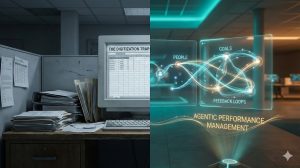
Traditional performance management is largely retrospective. It documents goals, feedback, ratings and outcomes. Modern, agentic performance management has the potential to continuously understand the context around performance and help identify meaningful changes over time.
Imagine a platform that can connect performance trajectory, goals, feedback, recognition, development conversations, career aspirations, team outcomes and commitments made in previous conversations.
Individually, those data points may not mean much. Together, they can reveal patterns that deserve attention.
A high-performing leader has taken on substantially more responsibility, but their development plan hasn’t changed. Someone repeatedly identified as ready for broader opportunities hasn’t had a meaningful career conversation in months. An employee continues to exceed expectations, but commitments made during previous development conversations haven’t been addressed.
None of these signals means someone is going to leave. Nor should an AI system make that determination.
What it can do is recognize that something may have changed and a conversation is warranted.
That’s an important distinction.
The technology surfaces the signal. The leader provides the judgment, context and human connection.
Improving Regrettable Turnover Starts Before Someone Decides to Leave
The most interesting opportunity for agentic performance management isn’t to remove managers from performance management. It’s to make them better equipped to do it.
An intelligent platform can continuously synthesize more information than any manager could reasonably hold in working memory. It can recognize patterns across time, identify exceptions, surface unresolved commitments and bring the right context forward when it matters.
Instead of expecting every manager to notice every weak signal, the system can help focus their limited attention on the places where a conversation, coaching moment, recognition or intervention may have the greatest impact.
That changes performance management from a periodic administrative process into something closer to a management intelligence system.
And it matters because retaining top talent and improving regrettable turnover isn’t simply an HR metric. It’s an enterprise-value issue. Your strongest people carry customer relationships, institutional knowledge, leadership capacity and future potential. Your best managers multiply that value across others.
Organizations will never prevent every regrettable departure, nor should that be the objective. People move on, careers evolve, and sometimes leaving is the right outcome.
The opportunity is to stop being surprised by disengagement that was developing in plain sight but was too subtle, fragmented or deprioritized to recognize.
Don’t wait to manage the exit. Manage the drift.